a
m
b
a
c
i
a
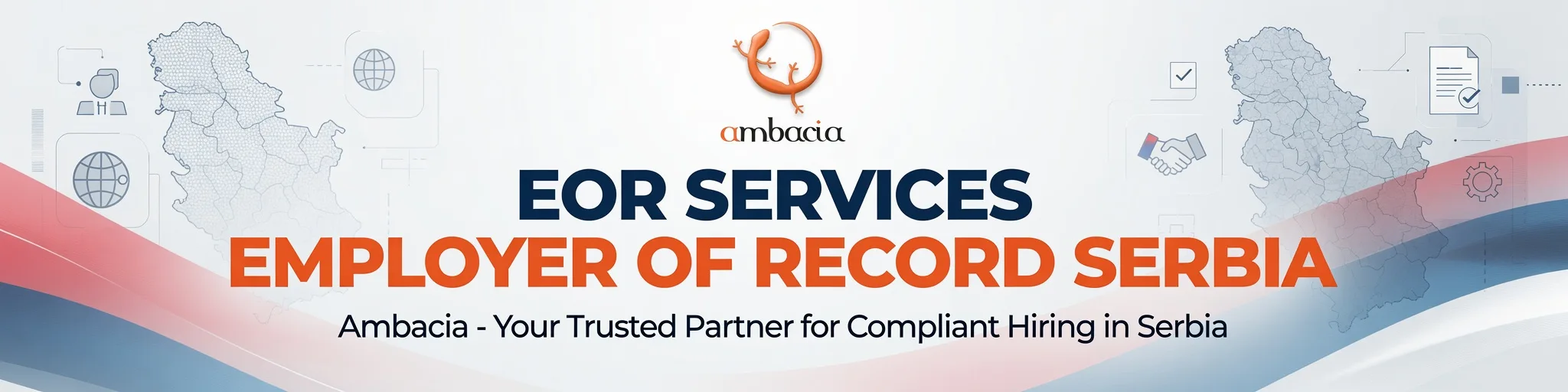

Serbia is becoming an increasingly attractive destination for entrepreneurs and international companies looking for skilled talent, especially in technology, engineering, and digital services. With a growing economy and a strong pool of professionals, the country offers significant opportunities for global businesses. However, hiring in Serbia can involve regulatory complexity, payroll requirements, and administrative challenges. Employer of Record (EOR) solutions provide companies with a flexible way to access Serbian talent without the need to establish a local entity. As Ambacia expands its EOR services into Serbia, the goal is to help businesses enter the market faster while maintaining compliance and operational simplicity.

Serbia is no longer a peripheral market in Southeast Europe. It is increasingly positioned as a competitive hub for digital talent, outsourcing services, and export-oriented knowledge work. For entrepreneurs and international companies, this shift is less about macroeconomic headlines and more about a practical reality: Serbia is now a place where highly skilled people can be hired, but not always through traditional employment structures.
The economy continues to grow at a moderate pace, supported by services, exports, and a strengthening tech sector. At the same time, companies face a familiar tension: strong talent availability on one side, and administrative, legal, and structural hiring complexity on the other.
This is where hiring models such as Employer of Record (EOR) become increasingly relevant, not as a trend, but as an operational solution.
Serbia's economic outlook remains cautiously positive, with steady growth supported by exports, services, and foreign investment. GDP growth is expected to remain stable in the mid single-digit range, even as global conditions fluctuate.
However, the more important story is structural, not cyclical.
Serbia is transitioning from a cost-driven economy to a skills-driven economy.
That shift is visible in three areas:
At the same time, businesses still report friction in the form of regulatory complexity, labour market constraints, and access to financing, especially for SMEs.
| Indicator | Situation | Business Impact |
|---|---|---|
| GDP growth | Stable moderate growth (3–4%) | Predictable but not high expansion |
| Labour market | Tight in skilled sectors | Competition for talent increasing |
| IT sector | Strong export growth | Key driver of global relevance |
| Regulation | Improving but complex | Slows down direct hiring |
| Workforce trend | Demographic decline risk | Long-term talent scarcity |
Serbia's most important export is no longer physical goods, but human capital.
The IT and digital services sector has grown significantly over the last decade, driven by global outsourcing demand and a strong technical education system.
Key characteristics of the talent pool:
This combination makes Serbian professionals highly competitive in global hiring markets.
However, it also creates a challenge: demand for talent increasingly exceeds the speed at which companies can hire locally.
Despite strong talent availability, many companies encounter obstacles when trying to hire in Serbia directly.
Common bottlenecks include:
For fast-moving companies, especially in tech and services, these delays can slow down growth significantly.
The classic approach to hiring in Serbia usually involves incorporating a local company, building HR infrastructure, and managing compliance internally.
This model works for large, long-term investments. But it is often inefficient for:
In these cases, operational overhead becomes disproportionate to business value.
Employer of Record (EOR) models allow companies to hire in Serbia without establishing a legal entity.
Instead of setting up local infrastructure, the EOR becomes the legal employer, while the client company manages day-to-day work.
What EOR changes operationally:
This allows companies to focus on execution instead of setup.
| Factor | Traditional Entity Model | EOR Model |
|---|---|---|
| Time to hire | Weeks to months | Days |
| Setup cost | High | Low |
| Compliance burden | Internal responsibility | Fully managed |
| Flexibility | Low | High |
| Best use case | Large scale operations | Agile hiring & market entry |
EOR is particularly relevant for:
Typical roles include software engineers, customer success managers, sales professionals, and operations specialists.
For entrepreneurs, Serbia represents both opportunity and complexity.
The opportunity is clear:
The complexity lies in execution:
The gap between these two is exactly where EOR becomes strategically useful.
Serbia's economy is moving toward higher value services, stronger digital exports, and deeper integration into global labour markets. But as demand for talent accelerates, traditional hiring structures are increasingly misaligned with how modern companies operate.
Employer of Record is not a replacement for local companies or long-term investment structures. It is a practical mechanism for speed, compliance, and flexibility in a market that is becoming more competitive by the year.
At Ambacia, we work within this shift by enabling companies to access Serbian talent without unnecessary friction, allowing them to scale faster while staying fully compliant.
Serbia's economic story is no longer just about growth. It is about how efficiently that growth can be accessed.
Serbia has become a popular destination for international hiring thanks to its strong pool of skilled professionals, particularly in software development, engineering, finance, customer support, and digital services. Competitive labour costs and a growing export-oriented economy also make it an attractive market for global businesses.
No. If you don't want to establish a Serbian company, you can hire employees through an Employer of Record (EOR). An EOR acts as the legal employer, handling payroll, taxes, employment contracts, and compliance while your team manages the employee's day-to-day work.
Using an EOR allows businesses to:
This approach is particularly useful for startups, scaleups, and companies making their first hires in Serbia.
Yes. Ambacia provides Employer of Record (EOR) services in Serbia, helping international businesses hire local talent without establishing a legal entity. The service covers employment contracts, payroll, statutory compliance, and HR administration, allowing companies to expand more efficiently while remaining compliant with Serbian regulations.
Some of the fastest-growing sectors include:
Demand continues to grow as more international companies build remote and distributed teams.
Yes. When companies use Ambacia's Employer of Record service, employment is managed in accordance with Serbian labour legislation. This includes compliant employment contracts, payroll processing, tax and social contribution management, and adherence to local employment requirements.
While hiring timelines depend on the candidate and documentation, using an Employer of Record is generally much faster than incorporating a local business. Companies can often onboard employees within days instead of waiting weeks or months for company registration and administrative procedures.
Ambacia's EOR solution is well suited for:
It offers a practical option for companies that need flexibility while growing internationally.
An EOR can help reduce or eliminate costs associated with:
Although an EOR has its own service fee, it can be a more cost-effective solution for companies with smaller or growing teams.
As Ambacia expands its EOR services into Serbia, the focus is on helping international businesses hire local professionals with less administrative complexity. Rather than replacing a long-term local presence, Ambacia provides a practical solution for companies that want to enter the Serbian market quickly, remain compliant, and scale at their own pace.